Note
Go to the end to download the full example code.
Using functions from other packages#
This example shows how to adapt functions from other packages to use them with MEEGsim.
import matplotlib.pyplot as plt
import mne
import numpy as np

from neurodsp.sim import sim_bursty_oscillation
from neurodsp.sim.multi import sim_multiple
from mne.datasets import sample

from meegsim.location import select_random
from meegsim.simulate import SourceSimulator
from meegsim.utils import normalize_variance
For this example, we use the sim_bursty_oscillation() function
from the NeuroDSP package. To make
the function compatible with MEEGsim, we need to wrap it in another function and
adapt the input and output parameters:
def bursty_osc(n_series, times, **kwargs):
    # Convert MEEGsim input to NeuroDSP input
    tstep = times[1] - times[0]
    n_seconds = times.max() + tstep
    fs = 1.0 / tstep

    params = dict(n_seconds=n_seconds, fs=fs)
    params.update(kwargs)

    # Random state is not accepted by NeuroDSP function, use it to set
    # random starting phase for some variability
    seed = params.pop("random_state")
    phase = np.random.default_rng(seed).random()
    params["phase"] = phase

    sims = sim_multiple(sim_bursty_oscillation, params, n_sims=n_series)

    return normalize_variance(sims.signals)
Load the source space and a head model for EEG channels:
# Paths
data_path = sample.data_path() / "MEG" / "sample"
fwd_path = data_path / "sample_audvis-meg-eeg-oct-6-fwd.fif"
raw_path = data_path / "sample_audvis_raw.fif"

# Load the prerequisites: fwd, src, and info
fwd = mne.read_forward_solution(fwd_path)
raw = mne.io.read_raw(raw_path)
src = fwd["src"]
info = raw.info

# Pick EEG channels only
eeg_idx = mne.pick_types(info, eeg=True)
info_eeg = mne.pick_info(info, eeg_idx)
fwd_eeg = fwd.pick_channels(info_eeg.ch_names)
Reading forward solution from /home/docs/mne_data/MNE-sample-data/MEG/sample/sample_audvis-meg-eeg-oct-6-fwd.fif...
    Reading a source space...
    Computing patch statistics...
    Patch information added...
    Distance information added...
    [done]
    Reading a source space...
    Computing patch statistics...
    Patch information added...
    Distance information added...
    [done]
    2 source spaces read
    Desired named matrix (kind = 3523 (FIFF_MNE_FORWARD_SOLUTION_GRAD)) not available
    Read MEG forward solution (7498 sources, 306 channels, free orientations)
    Desired named matrix (kind = 3523 (FIFF_MNE_FORWARD_SOLUTION_GRAD)) not available
    Read EEG forward solution (7498 sources, 60 channels, free orientations)
    Forward solutions combined: MEG, EEG
    Source spaces transformed to the forward solution coordinate frame
Opening raw data file /home/docs/mne_data/MNE-sample-data/MEG/sample/sample_audvis_raw.fif...
    Read a total of 3 projection items:
        PCA-v1 (1 x 10²)  idle
        PCA-v2 (1 x 10²)  idle
        PCA-v3 (1 x 10²)  idle
    Range : 25800 ... 192599 =     42.956 ...   320.670 secs
Ready.
Now we can use the adapted function in a simulation, providing the required
parameters via the waveform_params dictionary:
sim = SourceSimulator(src)

sim.add_point_sources(
    location=select_random,
    location_params=dict(n=2),
    waveform=bursty_osc,
    waveform_params=dict(  # NeuroDSP parameters
        freq=20,
        burst_def="durations",
        burst_params={"n_cycles_burst": 3, "n_cycles_off": 3},
    ),
    names=["lh", "rh"],
)

sc = sim.simulate(sfreq=250, duration=60, fwd=fwd, random_state=123)
We can check that the simulation of a bursty oscillation actually worked:
n_samples_to_plot = 500
fig, ax = plt.subplots()
ax.plot(sc.times[:n_samples_to_plot], sc["lh"].waveform[:n_samples_to_plot])
ax.set_xlabel("Time (s)")
ax.set_ylabel("Amplitude (nAm)")
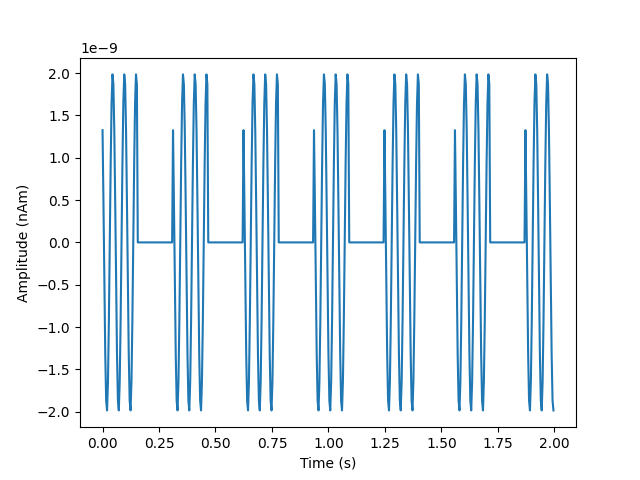
Text(31.097222222222214, 0.5, 'Amplitude (nAm)')
Note
Coupling methods provided by MEEGsim might not preserve specific properties of time courses generated via functions from other packages. (e.g., presence of bursts in this example).
Total running time of the script: (0 minutes 0.241 seconds)